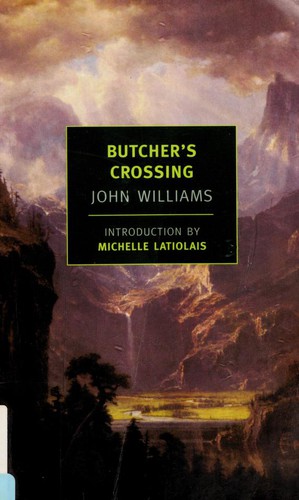
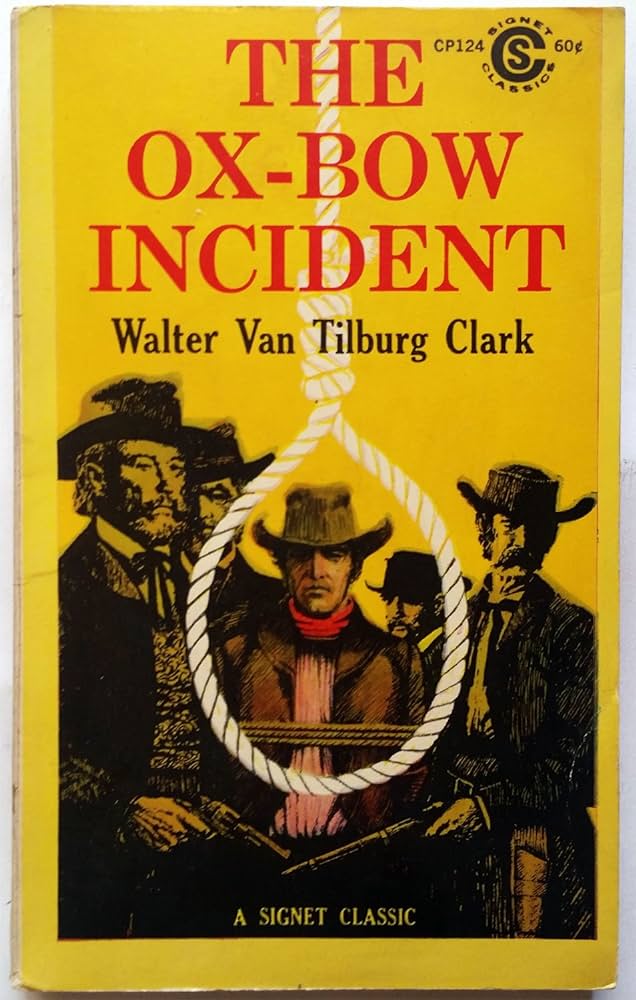
I like my books to either cover a small and specific event in great detail OR to cross generations, detailing only the most poignant moments. This does the former, detailing a single adventure but through such vivid writing that it seems like you can feel the heat of the campfire they are sharing, or the cold of the frozen ground they are sleeping directly upon!
"Tell Mr. Andrews about losing your hand, Charley," Miller said.
Charley Hoge grinned through his short, grizzled beard. He put the stump of his hand on the table and inched it toward Andrews as he spoke. "Miller and I was hunting and trapping early one winter in Colorado. We was up on a little rise just before the mountains when a blizzard come up. Miller and I got separated, and I slipped on a rock and hit my head and got knocked clean out of my senses. Don't know how long I laid there. When I come to, the blizzard was still blowing, and I could hear Miller calling."
"I'd been looking for Charley nearly four hours," Miller said.
"I must've knocked a glove off when I fell," Charley Hoge continued, "because my hand was bare and it was froze stiff. But it wasn't cold. It just kind of tingled. I yelled at Miller, and he come over, and he found us a shelter back in some rocks; they was even some dry logs, and we was able to keep a fire going. I looked at that hand, and it was blue, a real bright blue. I never seen anything like it. And then it got warmed up, and then it started to hurt; I couldn't tell whether it hurt like ice or whether it hurt like fire; and then it turned red, like a piece of fancy cloth. We was there two, three days, and the blizzard didn't let up. Then it turned blue again, almost black."
"It got to stinking," Miller said, "so I knew it had to come off."
Charley Hoge laughed with a wheezing, cracking voice. "He kept telling me it had to come off, but I wouldn't listen to him. We argued almost half a day about it, until he finally wore me down. He never would of talked me into it if I hadn't got so tired. Finally I just laid back and told him to cut away."
"My God," Andrews said, his voice barely a whisper.
"It wasn't as bad as you might think," he said. "By that time the hurt was so bad I could just barely feel the knife. And when he hit bone, I passed out, and it wasn't bad at all then."
In the early dawn, on the twenty-fifth day of August, the four men met behind the livery stable where their wagon, loaded with six weeks' provisions, waited for them. A sleepy stable man, scratching his matted hair and cursing mechanically under his breath, yoked their oxen to the wagon; the oxen snorted and moved uneasily in the faint light cast by a lantern set on the ground. His task completed, the stable man grunted and turned away from the four men; he shambled back toward the livery stable, swinging the lantern carelessly beside him, and dropped upon a pile of filthy blankets that lay on the open ground outside. Lying on his side, he raised the globe of the lantern and blew out the flame. In the darkness, three of the men mounted their horses; the fourth clambered into the wagon. For a few moments none of them spoke or moved. In the silence and darkness the heavy breathing of the stable man came regular and deep, and the thin squeak of leather upon wood sounded as the oxen moved against their yokes.
From the wagon Charley Hoge cleared his throat and said: "Ready?"
Miller sighed deeply, and answered, his voice muffled and quiet: "Ready."
Upon the silence came the sudden pop of braided leather as Charley Hoge let his bull-whip out above the oxen, and his voice, shrill and explosive, cracked: "Harrup!"
The oxen strained against the weight of the wagon, their hooves pawing and thudding dully in the earth; the wheels groaned against the hickory axles; for a moment there was a jumble of sound—wood strained against its grain, rawhide and leather slapped together and pulled in high thin screeches, and metal jangled against metal; then the sound gave way to an easy rumble as the wheels turned and the wagon slowly began to move behind the oxen.
Under the snow, between the skins that had only a few days before held together the flesh of the buffalo, his body rested. Slowly its sluggish blood generated warmth, and sent the warmth to his body's skin, and out to the close hide of the buffalo; thence his body gathered its own small warmth, and loosened within it. The shrill drone of the wind above him lulled his hearing, and he slept.
The old man, breathing heavily, came up shortly with two tubs, depositing one in Miller's and Charley Hoge's room and the other in Andrews's room.
Shoving the tub to the center of the floor, the old man looked curiously at Andrews, who remained sitting on the bed.
"By God," he said. "You men sure got a powerful stink to you. How long since you had a bath?"
Andrews thought for a moment. "Not since last August."
"Where you been?"
"Colorado Territory."
"Oh. Prospecting?"
"Hunting."
"For what?"
Andrews looked at him in tired surprise. "Buffalo."
"Buffalo," the old man said, and nodded vaguely. "I think I heared once they used to be buffalo up there."
Andrews did not speak. After a moment the old man sighed and backed toward the door. "Water'll be hot in a few minutes. Anything else you need, just let me know."
Andrews pointed to the heap of clothing on the floor beside the bed. "You might take these out with you, and get me some new ones."
The old man picked up the clothing, holding it in one hand, away from him. Andrews got a bill from his money belt and put it in the man's other hand.
"What'll I do with these?" the old man asked, moving the clothing slightly.
"Burn them," Andrews said.
"Burn them," the man repeated. "Any special kind of clothes you want from the dry goods store?"
"Clean ones," Andrews said.
"Well," McDonald said, "you had your hunt."
"Yes, sir."
"And you lost your tail, just like I said you would."
Andrews did not speak.
"That was what you wanted, wasn't it?" McDonald asked.
"Maybe it was, in the beginning," Andrews said. "Part of it, at least."
"Young people," McDonald said. "Always wanting to start from scratch. I know. You never figured that someone else knew what you was trying to do, did you?"
"I never thought about it," Andrews said. "Maybe because I didn't know what I was trying to do myself."
"Do you know now?"
Andrews moved restlessly.
"Young people," McDonald said contemptuously. "You always think there's something to find out."
"Yes, sir," Andrews said.
"Well, there's nothing," McDonald said. "You get born, and you nurse on lies, and you get weaned on lies, and you learn fancier lies in school. You live all your life on lies, and then maybe when you're ready to die, it comes to you—that there's nothing, nothing but yourself and what you could have done. Only you ain't done it, because the lies told you there was something else. Then you know you could of had the world, because you're the only one that knows the secret; only then it's too late. You're too old."