2025-07-30
LIFE MGMT
|
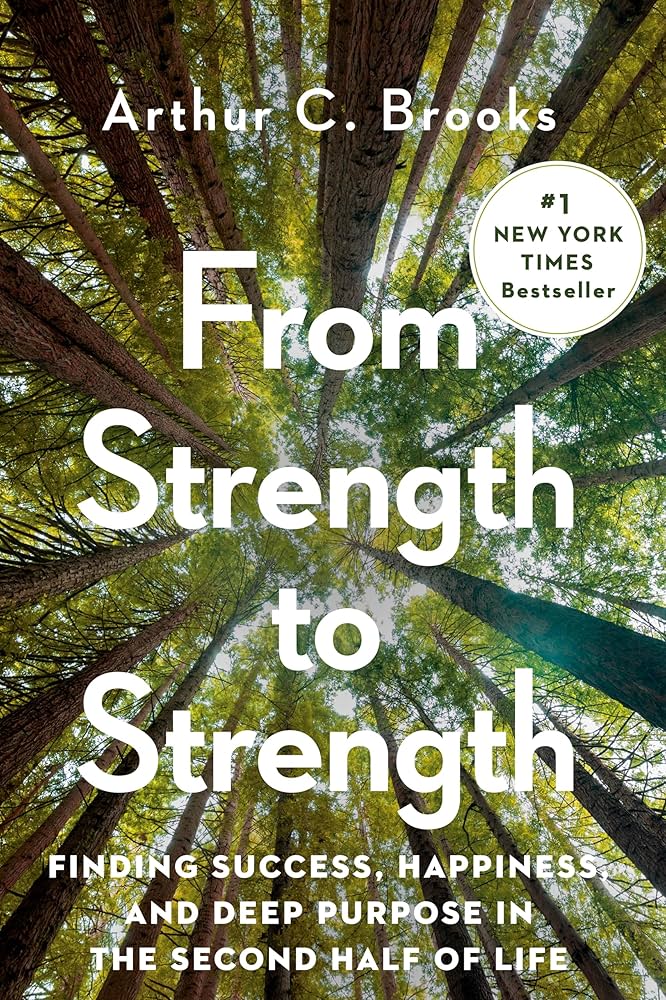
From Strength to Strength: Finding Success, Happiness, and Deep Purpose in the Second Half of Life
by Arthur Brooks
Publisher Note:
The roadmap for finding purpose, meaning, and success as we age, from bestselling author, Harvard professor, and the Atlantic's happiness columnist Arthur Brooks.
Many of us assume that the more successful we are, the less susceptible we become to the sense of professional and social irrelevance that often accompanies aging. But the truth is, the greater our achievements and our attachment to them, the more we notice our decline, and the more painful it is when it occurs.
Troy Note:
This made up for the less-than-hoped for showing from the How to Measure a Life book. Lots and lots of good stuff in here. Arther Brooks is a positive pshychology guy at Harvard and has done a good job synthesizing the global pursuit down into some actionable points.
The first thing I heard from him that caught my ear was how he explained our need for spritual satisfaction. Most people, at least I feel, just want to point you to this or that religion or faith. But Brooks said that what you seek through your spritual connection is something that makes you feel small. Given how we view and navigate the world, it is hard for it to not be a me-show. Having something in your life that reminds you this experience is not a me-show and that not only are we part of a pretty big situation, we are but the tiniest of blips in this production.
He also had an answer for why I have never experienced the burnout so many people in my age bracket tend to hit. That was elixer to an long-standing itch I’ve had wondering if I was deluded or simple. Grateful to put that worry aside and move onto better things (to worry about ;-)).
A lot of rich material to ponder for people heading towards our post-working , post-parenting phase of life. That accountant in all of our heads knows Freida McFadden books on the beach, sleeping late and binge-watching daily are empty calories for the mind and soul.
Passage(s) of Note:
Life is a treasure hunt. Go out and find the pot of gold, and then you can enjoy it and be happy for the rest of your life, even after your glory days are past. Go get rich and retire early. Go get famous and bask in the experience after it is past. Then when the success wanes, you can enjoy the memory of what you accomplished.
By this standard, the man on the plane I wrote about in the introduction should have been the happiest guy in the world. He was rich, famouse, and respected for what he had done long ago. He had won the race! The same goes for Darwinand Pauling. But they weren’t happy, because that model is all wrong. It is based on a completely misbegotten model of human striving. In fact, had the man on teh plane had an "ordinary" life—had he never accomplished something extraordinary—hi might not have felt so miserably irrelevant today.
We might call this the "principle of psychoprofessional gravitation": the idea that the agony of decline is directly related to presige previoulsy achieved, and to one’ emotional attachment to that prestige. If you have low expecations and never do much (or do a lot but maintain a Buddha-like level of non-attachment to your professional prestige), you probably won’t sugger much when you decline. But if you attain excellence and are deeply invested in it, you can feel pretty irrelevant when you inevitably fall the from those heights. And that is agony.
Great gifts and achievements early in life are simply not an insurance policy against suffering later on. On the contrary, studies show that people who have chased power and achievment in their professional lives tend to be unhappier after retirement than people who did not.
If you know just one song by the Rolling STones, it’s probably their 1965 megahit "(I Can’t Get N0) Satisfaction." It’s one of the most popular songs of all time, not because it’s such a great piece of music, but because it states a truth about life. Somewhere deep in our lizard brains, way below our level of consciousness, satisfaction is defined by this deviously simple equation:
Satisfaction - Getting what you want
It is so incredibly simple, even a baby follow it! Don’t believe me? Give a one-year old a French fry she’s reaching for and watch her expression. That’s more or less the same expression you got when you recieved you last huge raise or promotion at work. You really wanted it, you worked for it, and when you got it, the reward was deeply satisfying.
Deeply satisfying , that is, for a couple of days at most. And that’ sthe real problem, isn’t it? The song should really have been titled "(I Can’t Keep No) Satisfaction." We know more or less how to meet our desire for satisfaction but are terrible at making it last. It’s almost as if our brains wont’ let us enjoy anything for very long.
|