My only complaint, and it is a sizable one, is that this work is only a trilogy.
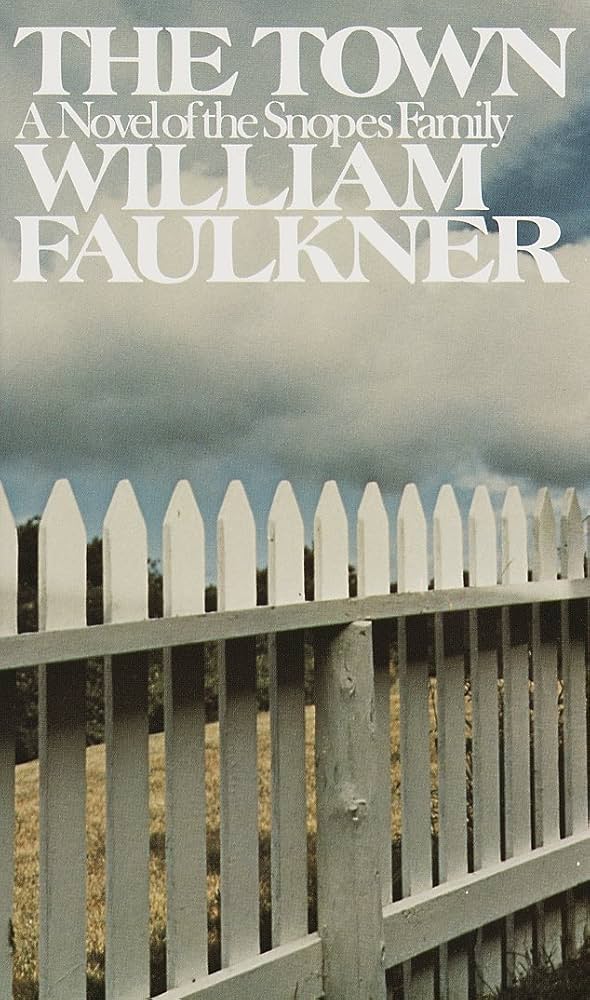
The number of times I clapped this book closed on my lap after a morning read staring ahead in wonder, I just can't say. And I am most definitely not one for spoilers, but when the "four half-Snopeses and half-Jicarilla Apache Indians" entered the narrative, well, I knew then I held in my hands one of the greatest works of narrative fiction ever penned.
Though it was not until two days later that the head auditor was ready to commit himself roughly as to how much money was stolen; by that time they had called a meeting of the bank's board of directors and even Mr. Varner that Jefferson County never saw once in twelve months, had come in and listened to the head auditor for about a minute and then said, "Police hell. Send somebody out home for my pistol, then show me which way he went."
He ran a still in the creek bottom by a spring about a mile and a half from his house, with a path worn smooth as a ribbon and six inches deep from his back door to the spring where he had walked it twice a day for two years until they caught him and took him to federal court before Judge Long, looking as surprised and innocent as if he didn't even know what the word 'still' meant while the lawyer questioned him, saying No, he never had any idea there was a still within ten miles, let alone a path leading from his back door to it because he himself hadn't been in that creek bottom in ten years, not even to hunt and fish since he was a christian and he believed that no christian should destroy God's creatures, and he had burned out on fish when he was eight years old and hadn't been able to eat it since.
Until Judge Long himself asked him how he accounted for that path, and Wilbur blinked at Judge Long once or twice and said he didn't have any idea, unless maybe his wife had worn it toting water from the spring; and Judge Long (he had the right name, he was six and a half feet tall and his nose looked almost a sixth of that) leaning down across the Bench with his spectacles at the end of his nose, looking down at Wilbur for a while, until he said: "I'm going to send you to the penitentiary, not for making whiskey but for letting your wife carry water a mile and a half from that spring."
And less than any did he possess that weapon which could have served him best of all: friendship, a roster of people whom he could have approached without fear or alarm and suggested or formed a cabal against De Spain. He had no friends. I mean, he knew he didn't have any friends because he had never (and never would) intended to have them, be cluttered with them, be constantly vulnerable or anyway liable to the creeping sentimental parasitic importunity which his observation had shown him friendship meant. I mean, this was probably when he discovered, for the first time in his life, that you needed friends for the simple reason that at any time a situation could—and in time would, no matter who you were—arise when you could use them; could not only use them would have to since nothing else save friendship, someone to whom you could say "Don't ask why; just take this mortgage or lien or warrant or distrainer or pistol and point it where I tell you, and pull the trigger", would do.
So I druv him by Frenchman's Bend. And we had the conversation too, provided you can call the monologue you have with Flem Snopes a conversation. But you keep on trying. It's because you hope to learn. You know silence is valuable because it must be, there's so little of it.