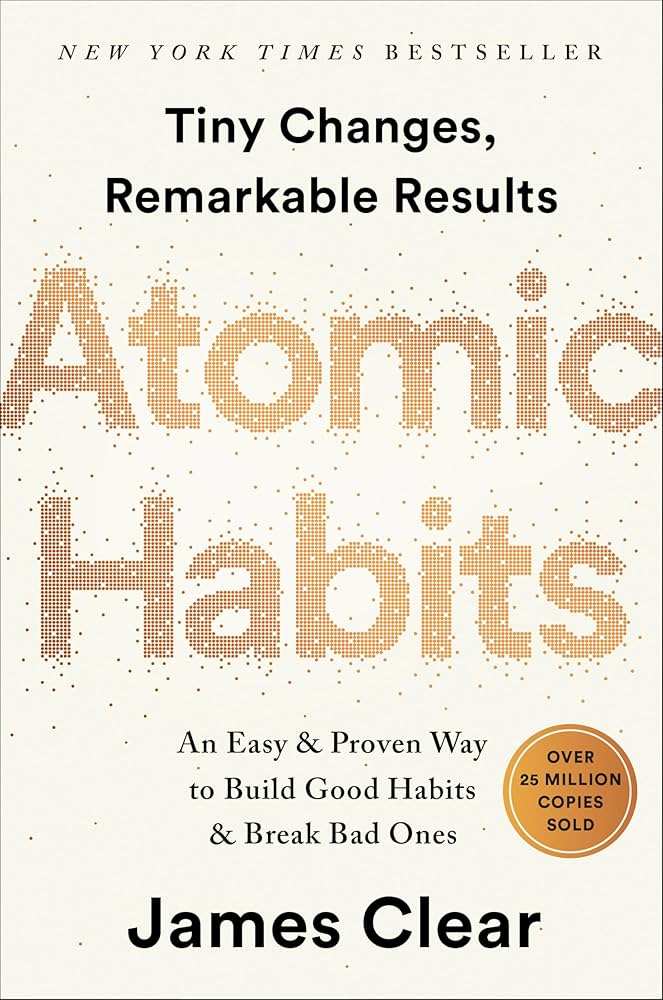
This book is a tremendous study of what may be a woefully misunderstood and tragically undervalued facet of human fulfillment and potential. As is often the case with some of the best material experts, the author came to know this subject organically given his life's cards.
I fancy myself a systems person but was left a bit rocked at how little I truly understood about the actual mechanics of habits. This book produced multiple mind-bending moments for me. Fact is I found it every bit as intriguing and twisty as all of the thriller-suspense books I read in the last few years. If only all treatises on human behavior could be this engaging.
In evidence, here are my hand-written notes which sought to record the more profound parts of the work as I took it in. A whole lot of meat in the pages of this one.
Click to view full document
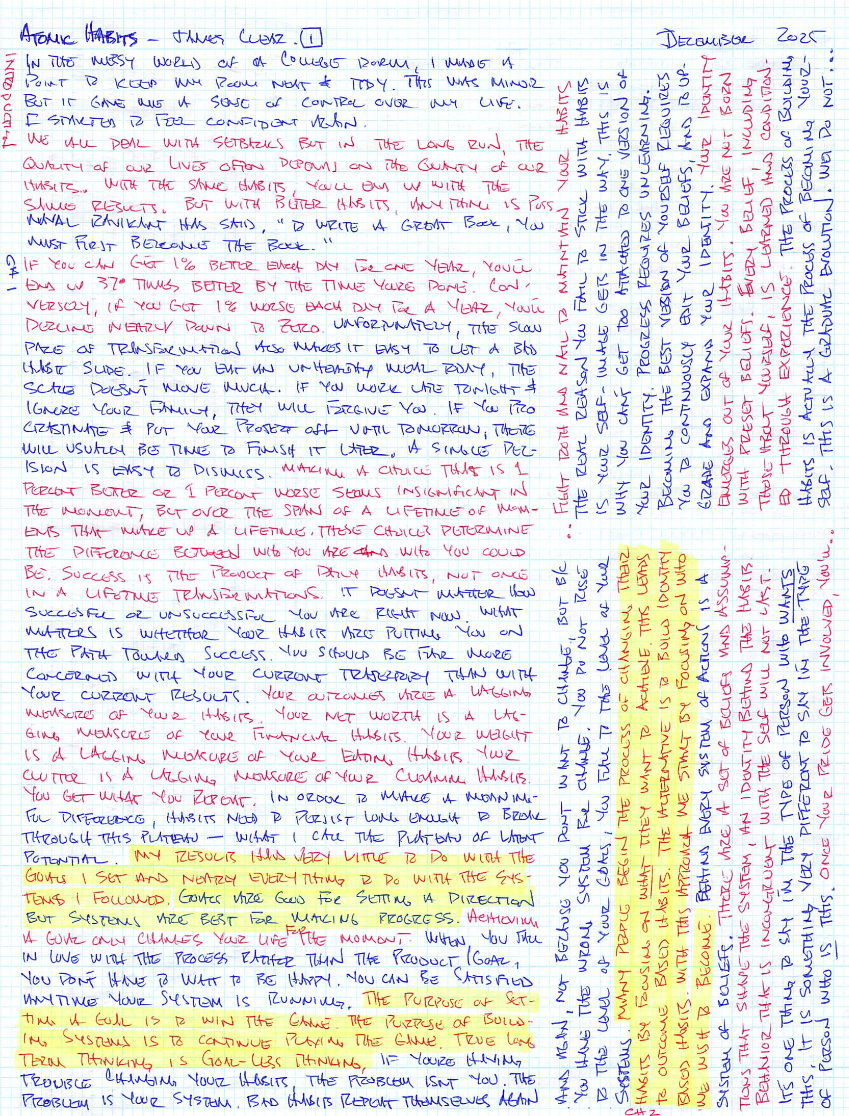
Meanwhile, improving by 1 percent isn't particularly notable—sometimes it isn't even noticeable—but it can be far more meaningful, especially in the long run. The difference a tiny improvement can make over time is astounding. Here's how the math works out: if you can get 1 percent better each day for one year, you'll end up thirty-seven times better by the time you're done. Conversely, if you get 1 percent worse each day for one year, you'll decline nearly down to zero. What starts as a small win or a minor setback accumulates into something much more.
Goals are good for setting a direction, but systems are best for making progress. A handful of problems arise when you spend too much time thinking about your goals and not enough time designing your systems.
Every action you take is a vote for the type of person you wish to become. No single instance will transform your beliefs, but as the votes build up, so does the evidence of your new identity. This is one reason why meaningful change does not require radical change. Small habits can make a meaningful difference by providing evidence of a new identity.
Habits do not restrict freedom. They create it. In fact, the people who don't have their habits handled are often the ones with the least amount of freedom.
Researchers estimate that 40 to 50 percent of our actions on any given day are done out of habit. This is already a substantial percentage, but the true influence of your habits is even greater than these numbers suggest. Habits are automatic choices that influence the conscious decisions that follow. Yes, a habit can be completed in just a few seconds, but it can also shape the actions that you take for minutes or hours afterward.
The most effective way I know to counteract this tendency is to use the Two-Minute Rule, which states, "When you start a new habit, it should take less than two minutes to do."
The idea is to make your habits as easy as possible to start. Anyone can meditate for one minute, read one page, or put one item of clothing away. And, as we have just discussed, this is a powerful strategy because once you've started doing the right thing, it is much easier to continue doing it. A new habit should not feel like a challenge. The actions that follow can be challenging, but the first two minutes should be easy. What you want is a "gateway habit" that naturally leads you down a more productive path.
I try to remind myself of a simple rule: never miss twice. Missing once is an accident. Missing twice is the start of a new habit.
genes do not determine your destiny. They determine your areas of opportunity.
Boiling water will soften a potato but harden an egg. You can't control whether you're a potato or an egg, but you can decide to play a game where it's better to be hard or soft. If you can find a more favorable environment, you can transform the situation from one where the odds are against you to one where they are in your favor.
With our bad habits, the immediate outcome usually feels good, but the ultimate outcome feels bad. With good habits, it is the reverse: the immediate outcome is unenjoyable, but the ultimate outcome feels good. The French economist Frédéric Bastiat explained the problem clearly when he wrote, "It almost always happens that when the immediate consequence is favorable, the later consequences are disastrous, and vice versa.
As a general rule, the more immediate pleasure you get from an action, the more strongly you should question whether it aligns with your long-term goals.
The greatest threat to success is not failure but boredom. As Machiavelli noted, "Men desire novelty to such an extent that those who are doing well wish for a change as much as those who are doing badly."
Until you work as hard as those you admire, don't explain away their success as luck.