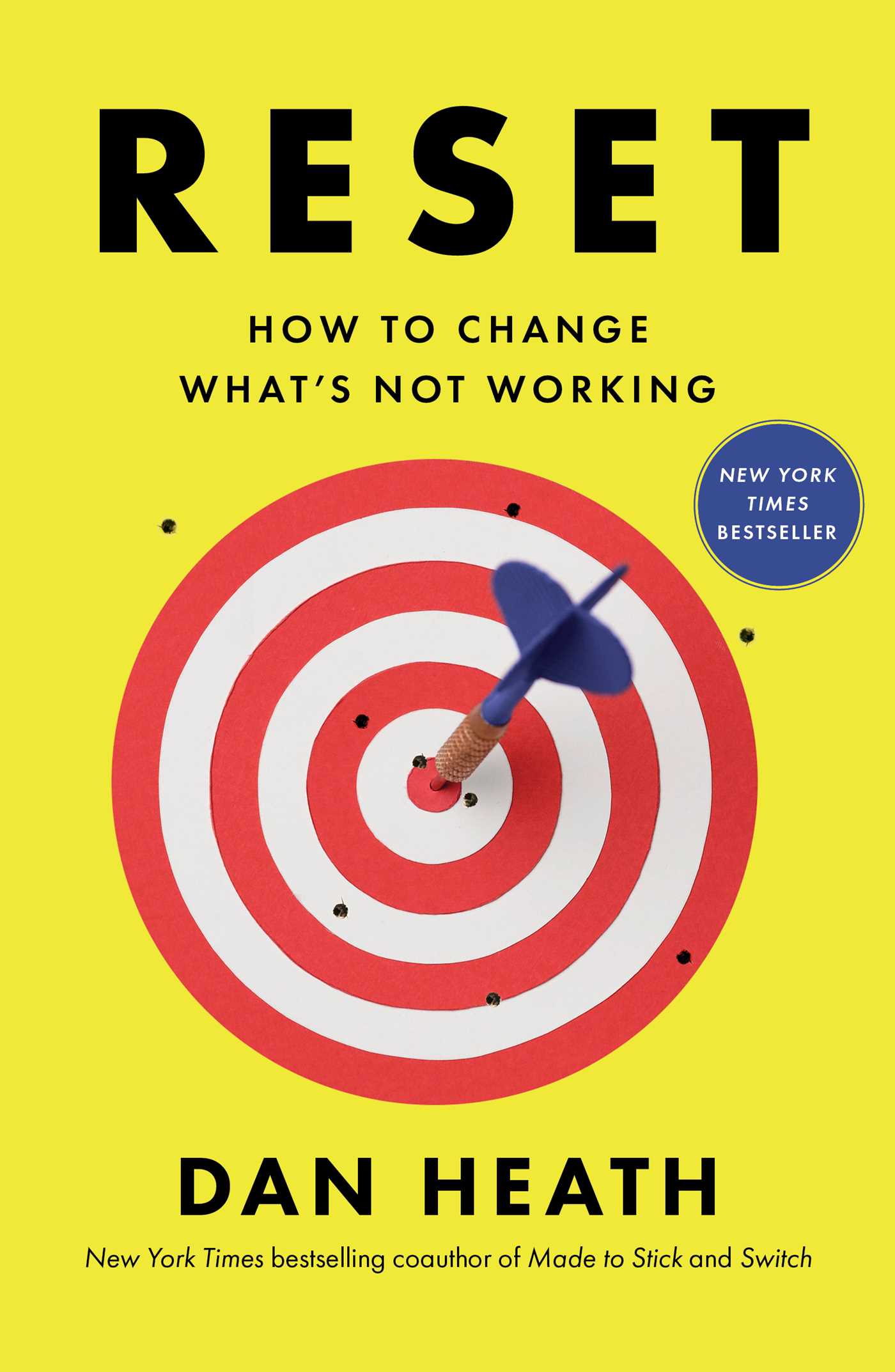
Life is a long string of decisions. The trajectory of our journey is governed, very significantly, by the endless cascade of decisions we make. This book examines the critically important skill of fostering change when our decisions are not achieving the positive course-corrections we want or require.
Three words in this book (on page 123) disrupted my hard-earned mental peace more than I would have thought possible. "Habits conceal waste." My days are ruled by what most would deem a maniacal amount of structure. Wanna question that? When I wake on Monday morning, every hour of the week ahead is already set (yes there is room for the unexpected and there is even time blocked for relaxing or what my wife and I call "the spontenaity"). While I know virtually everyone has opinions about my lifestyle, mostly negative, I can provide 37 examples of how these routines have dramatically improved my life and mental well being. But as I said those three words pushed their way into my mind's waiting room and proved to be a surprisingly noisy patron. But this is why we read, no?
Thankfully, Heath is no tourist and gives droves of real-world and varied exmaples to bring you to the conversation and give you a fighting chance to make meaningful progress. Note the first quote below that speaks directly to this point which references two of life's most critical postulates:
progress = happiness
meaningful progress = elation
What emerged from these diaries was a crystal-clear finding that the researchers called the progress principle: "Of all the things that can boost emotions, motivation, and perceptions during a workday, the single most important is making progress in meaningful work." According to the employee diaries, 76% of people's best days involved progress; only 13% of their best days involved setbacks.
Progress energized people and made them happy. Setbacks did the opposite. No other work dynamics had as dramatic an effect on employees' inner life.
What's particularly striking about the research, as Amabile and Kramer chronicle in their book The Progress Principle, is that most bosses were oblivious to the value of progress as a motivator. "When we surveyed managers around the world and asked them to rank employee motivators in terms of importance, only 5% chose progress as #1," said Amabile in a speech. "Progress came in dead last."
The problem comes when we mistake functional understanding for systemic understanding. We think because we can use something, because it operates as we expect, that we understand it. And that's a problem, because when the bike or the zipper or the toilet stops working, we're sunk. We realize that underneath our functional level of understanding, there's nothing.
One simple way to avoid that misalignment—a goal that's inconsistent with the real mission—is to ask a simple but powerful question: What's the goal of the goal?
The British advertising guru Rory Sutherland gave a great example of this idea in action. In 2007, Eurostar had finished upgrading the rail route from London to Paris, shaving the travel time from 2 hours 35 minutes to 2 hours 15 minutes. The total price tag was roughly £6 billion, and the goal of the investment had been to speed up the route. Mission accomplished. But what was the goal of the goal?
If the goal, ultimately, was to make things better for the passengers, was that investment well spent? Sutherland was dubious. "For 0.01% of this money, you could have put Wi-Fi on the trains, which wouldn't have reduced the duration of the journey, but would have improved its enjoyment and its usefulness far more," he said in a 2011 speech. "For maybe 10% of the money, you could have paid all of the world's top male and female supermodels to walk up and down the train handing out free Château Pétrus to all the passengers. You'd still have five billion pounds in change, and people would ask for the trains to be slowed down."
What Knies was doing—without realizing it—was honoring a motivational strategy that comes from Miguel Brendl, a professor of marketing at the University of Basel. "Early in your pursuit of your goal, look backwards at what you have achieved; toward the end, look forward," he told a reporter. Brendl's idea makes intuitive sense: If you have a goal to lose 10 pounds, it's motivating to see those first few pounds drop off. I lost one pound! Two! Then, as you reach the halfway point, it seems more motivating somehow to flip your lens and start counting down to the goal: Only four pounds left to go… three… two… one.
The ultimate effect of this "look backward, then look forward" strategy is to minimize the middle. Because in change efforts, the middle is the biggest trouble spot. In the beginning, there's an initial burst of energy: hope, novelty, adventure. It's the first few miles of a marathon. Then, later, you get a second burst as the finish line approaches: pride, satisfaction, relief.
But in the middle there's… nothing. Just a slow dog paddle forward, unbuoyed by the natural excitement of starts and finishes. It's the Battle of Midway.
Eby is taking the time to understand the values of his patient AND to explain how those values are served by adopting healthy behaviors. Because dispensing advice is worthless unless the patient is willing to act. So Eby starts with a clear understanding of what the patient wants.
As the great solution-focused therapist John J. Murphy said, "You can't rearrange the furniture unless you're invited into the house."